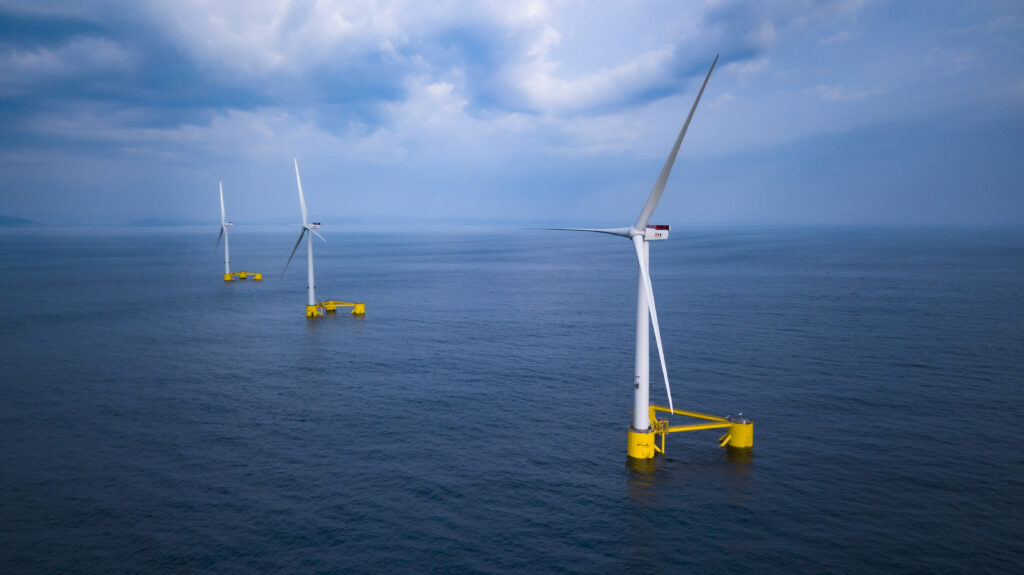
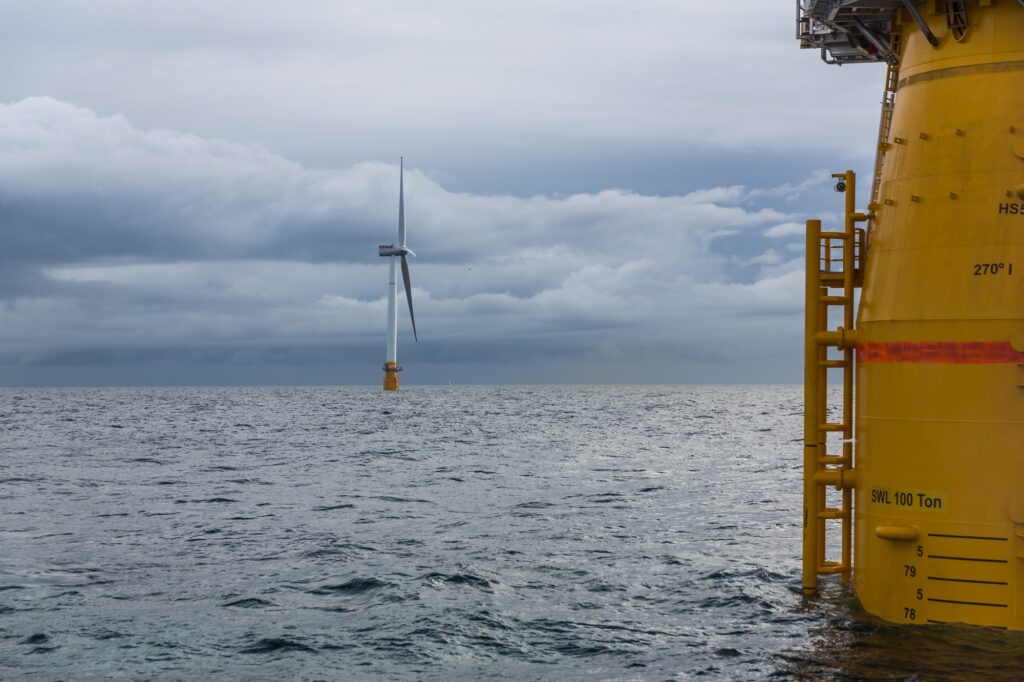
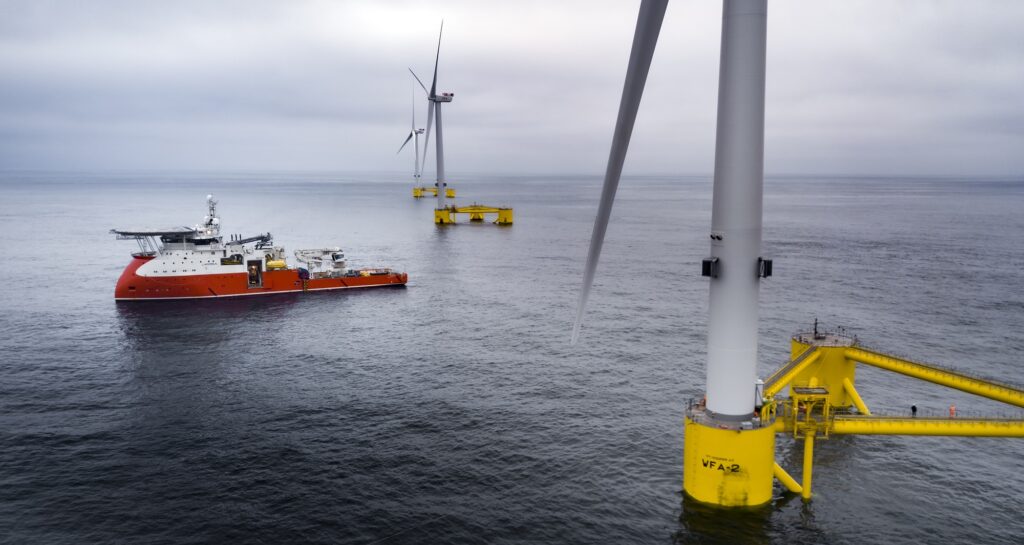
This study establishes a practical framework for the monitoring, repair, and maintenance of mooring systems and dynamic cables in floating offshore wind farms. The study assumes a representative 900 MW North Sea site as a case study, examining failure behaviour, repair methodologies, and operational constraints. At this scale, arrays comprise hundreds of mooring lines and dynamic cable systems, resulting in significant operational, logistical, and cost implications.
Mooring failure is a major concern for floating wind arrays, due to the cost of repair, and the potential for more serious cascading consequences. Decades of oil and gas mooring experience shows that mooring failure is inevitable at the Gigawatt array scale; mooring systems must be designed for repair.
Mooring failures may range from isolated events with specific causes, to systemic degradation requiring large‑scale replacement campaigns. Single mooring line repairs can typically be completed within approximately 4–6 vessel days at a cost of around £1 million per event. Winter weather downtime can double or triple this cost. Larger replacement campaigns scale rapidly, with replacement of 36 lines (10% of the array) requiring 1–2 months of vessel time and a cost of £7 million. Replacing half of the mooring lines in an array (180 lines), which is a credible scenario for systematic mooring integrity issues, can extend beyond 200 days with costs in excess of £30 million.
It is also imperative that mooring design and integrity response planning prevents single line failures from cascading to corner failure or free drift. Most recorded integrity issues have proven to be systematic, which increases the risk of failure for multiple lines. The consequence of corner failure or free drift can exceed £100 million. If not properly assessed and mitigated, such events give intolerable risk at the Gigawatt array scale. A risk-based approach is recommended to eliminate, mitigate, and detect mooring integrity risks.
Efforts to reduce these risks are hindered by lack of sharing of mooring integrity and performance lessons learned on floating wind demonstrator projects. This is a missed opportunity for the sector as it allows critical exposures to be replicated on multiple systems.
End‑to‑end inter‑array cable replacement can typically be completed within approximately 15 days under favourable conditions, costing £5 million in vessel hire. More complex repair joint operations require longer durations and are significantly more sensitive to weather downtime.
Weather downtime is shown to be a key driver for repair cost, with winter operations on average taking twice as long and incurring double the cost compared to equivalent summer activities. This effect increases disproportionately with the scale of intervention, such that cable repair and large scale mooring replacement campaigns become highly dependent on favourable seasonal windows. A two week cable repair operation in summer conditions increases to 1 to 3 months in winter conditions.
Array cable risk is driven by the interaction between weather conditions, lead time, and lost revenue impact. The extent of lost revenue depends on cable topology and fault location. In high curtailment scenarios where the array has limited redundancy for power transfer, immediate repair during winter may be more cost‑effective, despite increased vessel costs. However, for weather‑sensitive operations, delaying intervention to favourable seasonal windows can reduce overall cost. Vessel availability may be limited for immediate repair during periods of peak construction demand, or when responding to multiple failures caused by the same storm. Operators can expect to pay a premium vessel day rate for short term repair operations in such periods.
Overall, there is no one approach that is optimised for all cases. A robust maintenance strategy should explore a range of scenarios and be adaptable. Decision‑making should include consideration of integrity risk, spares and vessels availability, production downtime, and weather downtime.